




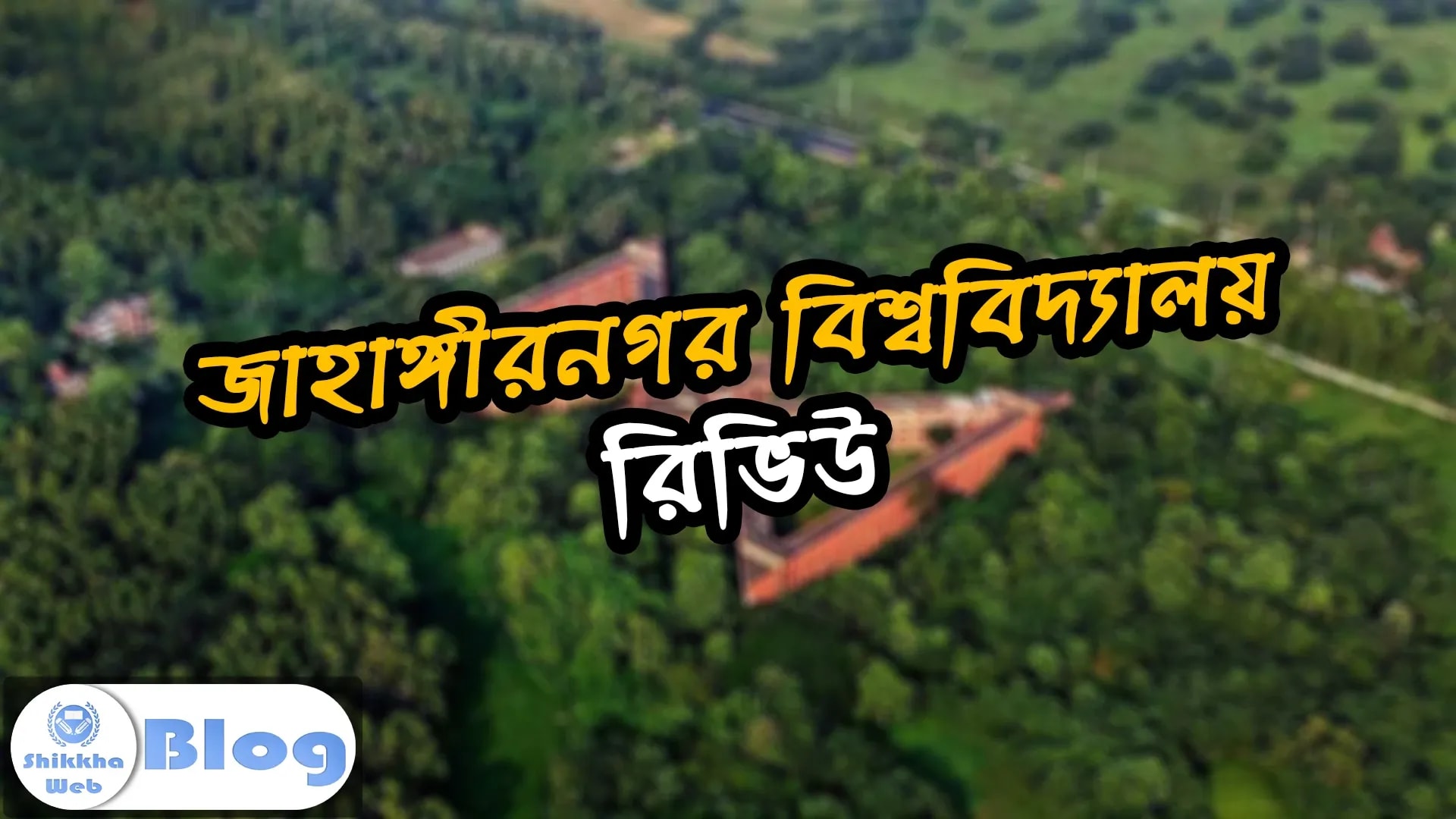
Jahangirnagar University is a university wrapped in green and full of natural beauty. To many students Jahangirnagar University — JU for short — is another name for a dream. The institution has won the hearts of a great many students through its looks alone. That is why JU has another name: Jaanbibi, an affectionate play on its initials.

Entrance
Location and introduction
Jahangirnagar University is one of Bangladesh's foremost, and its only fully residential, public universities. It stands over about 697.56 acres in the Savar area just outside Dhaka. The university campus is bounded to the north by the National Martyrs' Memorial, to the north-east by Savar Cantonment, to the south by the Bangladesh Public Administration Training Centre and to the east by a large dairy farm. The university's verdant setting and biodiversity are extremely charming. Its numerous water bodies have made it a sanctuary for migratory birds, which makes it a favourite place for birdwatchers.
The university was founded in 1970 as Jahangirnagar Muslim University. Its work began fully in 1972, and in 1973 its name was changed to Jahangirnagar University. Green Jahangirnagar began its journey with 150 students in four departments in the first batch: economics, geography, mathematics and statistics.

Campus
Faculties
At present the university has 35 departments under 6 faculties. They are:
Faculty of Mathematical and Physical Sciences: 1. Department of Mathematics 2. Department of Statistics 3. Department of Chemistry 4. Department of Physics 5. Department of Geological Sciences 6. Department of Computer Science and Engineering 7. Department of Environmental Sciences
Faculty of Social Sciences: 1. Department of Economics 2. Department of Geography and Environment 3. Department of Government and Politics 4. Department of Anthropology 5. Department of Urban and Regional Planning 6. Department of Public Administration
Faculty of Arts and Humanities: 1. Department of Bengali 2. Department of English 3. Department of History 4. Department of Philosophy 5. Department of Drama and Dramatics 6. Department of Archaeology 7. Department of International Relations 8. Department of Journalism and Media Studies 9. Department of Fine Arts
Faculty of Biological Sciences: 1. Department of Botany 2. Department of Zoology 3. Department of Pharmacy 4. Department of Biochemistry and Molecular Biology 5. Department of Microbiology 6. Department of Biotechnology and Genetic Engineering 7. Department of Public Health and Informatics
Faculty of Business Studies: 1. Department of Finance and Banking 2. Department of Marketing 3. Department of Accounting and Information Systems 4. Department of Management Studies
Faculty of Law: 1. Department of Law and Justice

Department of Physics
Institutes
1. Institute of Business Administration (IBA) 2. Institute of Information Technology (IIT) 3. Institute of Remote Sensing 4. Bangabandhu Institute of Comparative Literature and Culture

Muktomoncho
Facilities
Lab facilities and research opportunities: JU has ample lab facilities and a range of research equipment. For students and teachers thirsty for knowledge there is a large library and laboratory. There are also: – Language Learning Centre – Wazed Miah Science Research Centre – Internet Management Centre – Centre of Excellence in Teaching and Learning There is a medical centre for healthcare.
Natural beauty: JU is brimming with natural beauty. It is not only that the campus is full of natural beauty — guest birds gather here too. One of the world's largest butterfly fairs is held here. Every winter the bird fair raises the national and international standing of the campus a great deal.

Guest Birds
Teacher–student relations: JU is probably the only university in Bangladesh where a warm relationship exists between teachers and students. Here the students think of the teachers as guardians, and the teachers think of the students as their own children. If someone here falls ill, the whole campus rises together to bear the cost of treatment. Everyone works day and night to save a fellow JU student. Film festivals are held here to raise money for flood victims or for those suffering in the cold. Films are screened to raise money for the treatment of the child of poor parents too.
Transport:
JU provides buses for its students. Buses are also provided for the teaching staff.

Transport
JU-ism:
A deep bond exists between the seniors and juniors of JU. Students here have a shared identity: their batch. So far there are 48 batches in all, from 1 to 48. Say someone goes on a tour to Bandarban. The ASP on duty there is a former JU student. If he learns that someone from JU has come, he will drop a hundred tasks and turn up, and the two of them will talk as though they were brothers who had known each other for ages. This warmth among JU people seems God-given, and it has carried on unbroken from batch to batch.
Inspiration from famous people:
The most successful vice-chancellor of this university, Professor Sharif Enamul Kabir, is the country's finest in academic excellence. He has more than 350 original research papers, and this professor of chemistry is at present a member of the Bangladesh Public Service Commission. The present vice-chancellor, Professor Farzana Islam, is the country's first woman vice-chancellor; with affection and sincerity she carries out her duties to the campus with dedication. The country's famous physicist Professor Mamun is at present of JU's physics department. Mashrafe Bin Mortaza, dear to tens of millions of Bangladeshis, was a student of the 33rd batch of JU's philosophy department. Mushfiqur Rahim, among the country's finest captains, was a student of the 36th batch of this university's history department. Bangladesh's finest swimmer Mahfizur Rahman Sagar, and Sharmin Supta, a leading member of the women's cricket team, are students of this green campus. The late powerhouse actor Humayun Faridi was a JU student. Among the living, Shahiduzzaman Selim, Mili of Monpura, Subhashish Bhowmik, Faruk Ahmed, Subhashish Sinha, Sumaiya Shimu, Momo, Sajal and others were students of Jahangirnagar University.

Mir Mosharraf Hossain Hall
Residential halls
Jahangirnagar University is one of Bangladesh's residential universities. At present the university has 16 halls in all — 8 for men and 8 for women — and some more halls are under construction. The halls: 1. Al Beruni Hall 2. Mir Mosharraf Hossain Hall 3. Shaheed Salam-Barkat Hall 4. A. F. M. Kamaluddin Hall 5. Maulana Bhashani Hall 6. Bangabandhu Sheikh Mujibur Rahman Hall 7. Fazilatunnesa Hall 8. Nawab Faizunnesa Hall 9. Pritilata Hall 10. Jahanara Imam Hall 11. Begum Khaleda Zia Hall 12. Shaheed Rafiq-Jabbar Hall 13. Sheikh Hasina Hall 14. Begum Sufia Kamal Hall 15. Bangamata Sheikh Fazilatunnesa Hall 16. Bishwakabi Rabindranath Tagore Hall
Besides this, every hall has a dining hall, indoor gaming facilities, a separate reading room, a TV room for recreation and good wifi provision.

Bangabandhu Sheikh Mujibor Rahman Hall
Campus life
JU's campus life is as varied and as full of joy as its own looks. Every corner of JU rings with the unbroken bond of respect, regard and affection between seniors and juniors. Every year Jaanbibi dresses up like a new bride to welcome the incoming students, and the seniors take the newcomers as their own. JU comes alive with the footsteps of the freshers. The country's largest alpona has been drawn at JU. Every year Martyrs' Day, Independence Day and Victory Day are observed with respect. Pohela Boishakh, JU Day, the spring festival, the winter festival and the pitha festival are celebrated with joy. Alongside these there are of course departmental events, tours, concerts and inter-departmental competitions. JU has an auditorium with a capacity of 1,500 people, well equipped for staging various cultural events. There is also the teacher-student centre, known in short as the TSC. JU's central cafeteria provides food at affordable prices and has 29 staff running it. And then there is JU's Bottola, famous for its food.

Pahela Boishakh
Sculptures
Shaheed Minar Its architect is Rabiul Hussain. Built as a symbol of the Language Movement of 1952 and the Liberation War of 1971, this Shaheed Minar — 52 feet in diameter and 71 feet high, the tallest in Bangladesh — stands at JU. It has 8 steps and 3 pillars.

Shaheed Minar
Sangsaptak In front of the university library stands Sangsaptak, a memorial sculpture of the Liberation War. In it a sangsaptak freedom fighter, having lost one leg and one arm, holds the weapon of victory aloft. Its sculptor is Hamiduzzaman Khan.
Amar Ekush In front of the social sciences building, beside the teacher-student centre, stands Amar Ekush, a sculpture in memory of the Language Movement. Its sculptor is the artist Jahanara Parveen.
There are also Kabir Sharani, Munni Sharani, Zubair Sharani and Swapna Sharani.

Sculpture
Organisations
The university has various student organisations:
Science movement platform: – Bangladesh Open Science Organization – Jahangirnagar University Science Club – Jahangirnagar University Physics Club – E-Commerce and Entrepreneurship Organisation
Cultural: Notable cultural organisations include Jahangirnagar Theatre, Dhwani, Cholochchitro Andolon, Jolshiri, Zahir Raihan Film Society, Anandan, Charan Cultural Centre, Jahangirnagar Photographic Society, Jahangirnagar University Career Club, Jahangirnagar University Debate Organization, Jahangirnagar University Debating Society, Utthanpath, Propod, Jahangirnagar Students' Film Society, Kahankatha, Ostitto and others.
Jahangirnagar Cultural Alliance: The alliance has 12 organisations: Jolshiri, Charan Cultural Centre, Dhwani, Cholochchitro Andolon, Zahir Raihan Film Society, Jahangirnagar University Debate Organization, Anandan, Jahangirnagar Theatre, Jahangirnagar University Debating Society and Jahangirnagar University Photographic Society.
Various service and voluntary organisations also work at Jahangirnagar University.
The admission test
Jahangirnagar University's undergraduate admission test is, it must be said, like a battlefield, because a second-time attempt is allowed. JU's admission test is usually held within October and November. The test is out of 100 marks in total, of which 20 are counted from the GPA, while the main admission test is 80 marks by MCQ. The time set for the test is 55 minutes in all. Since a great many students sit each unit's admission test and the test is held on campus, every unit's test takes place in several shifts. One interesting point is that every unit's admission test at JU has questions from one common subject: intelligence.
Final words
If your dream is the JU you love, and if you want to make that dream real, then no more delay — start studying. Not from tomorrow but from this very moment, begin the journey towards your dream, because time waits for nobody.